TurboTax
Income
- Agents
- Growth
Shipping and scaling the self-employed income qualification agent to 800K users
Role
Timeline
Stage
Collaborators
Highlights
- Shipped Self-Employed Income Qualification Agent v2 to help 800K filers determine their Schedule C eligibility
- Expanded scope across supplemental income (rental, sale, farm), redesigned start chips, and improved out-of-scope handling, driving 70% task completion rate and achieving 90% accuracy.
- A/B tested a new entry point at the January task peak, lifting click-through rate from 4.4% to 6% over the baseline, with the engagement win holding through the filing season
Context
Income qualification is one of the biggest friction points for first-time self-employed filers—especially part-timers and side-giggers. The root of the problem is a fundamental mental mismatch: a gap between how a person describes what they do to earn extra money and the equivalent IRS tax definition.
When faced with traditional tax jargon, customers struggle to self-diagnose. As one research participant put it: "Am I a freelancer or gig-worker? So at this point I would probably google it."
This confusion causes severe funnel friction and accuracy issues:
High abandonment: Around two-thirds of new customers entering the SE topic never enter SE income, and roughly the same share of those who reach this gap abandon the flow entirely.
Missed outcomes: Of the customers who did push through and file, an estimated 10–15% likely missed deductions or credits they were actually eligible for.
The challenge wasn't just getting people through the screens—it was getting them to the correct financial outcome. We needed an experience that could bridge two very different mental models without relying on static help articles:
I don't see myself as a business owner. I'm just trying to earn some extra income.
My business is my livelihood so I need to ensure I'm making the right decisions to grow it.
Overview
I shipped v2 of the agent in October 2025 — a redesigned entry with start chips and clearer in-conversation guidance, broader scope across supplemental income types (rental, sale, farm), and better handling of duplicate 1099-NEC/MISC cases. Customers we interviewed called it reassuring — especially the moment it confirms which 1099 they're holding.
It made it less overwhelming, especially when I really didn't know what to file as.
It was actually super helpful. I think, especially because it's the first time I'm doing this, this was kind of like an accidental brand new career that I wasn't expecting to do. It was great.
Approach
v2 expanded scope well beyond what v1 had seen in production, so I didn't have a reliable historical baseline to lean on. I leaned heaviest on ML eng, evals, and design — the three places where the agent's quality, behavior, and entry-point reading lived. The work split into two parallel arcs: a quality and scope expansion (v2 in October) and an entry-point bet for the tax-season peak (the rainbow-gradient "Help me decide" A/B).
Eval discipline mattered more than usual here. Without prior production traffic at the v2 scope, the question wasn't "is the agent good" — it was "good enough across which cases, and where is it brittle." Prompt-only optimization drove most of the quality gains; we kept a 100-sample eval running against thresholds as scope expanded so we could push on growth and see where quality moved in either direction.
Completeness was the one metric that moved the wrong way. The regression came from two places: premature "cannot determine" conclusions on certain trigger words — the same failure mode that became one of v2's named challenges below — and a late-season population shift, when extension filers with more complex situations skew the late season harder to qualify.
Solutions
To solve this, we built the Self-Employed Income Qualification Agent. Instead of forcing users to translate their lived experiences into tax code, the agent takes the user's natural language inputs and does the translation for them.
Through a dynamic, back-and-forth conversational flow, the agent asks clarifying questions to evaluate specific tax decision criteria—such as identifying a clear "intent to profit." It then returns a definitive "yes" or "no" confirmation regarding whether their work qualifies for Schedule C reporting.
An earlier v1 of the agent had proven this basic bet: an adaptive AI interview significantly reduced confusion compared to static help articles. What it hadn't proven yet was whether an agent could earn enough trust at the entry point to get people to engage in the first place, or if it could hold up across the long tail of complex cases—like supplemental income, ambiguous 1099s, day trading, and foreign income.
Conversion ultimately validated the experiment, showing an incrementally positive lift across the full 375K population tested. Because engagement moved so decisively, we were able to prove that getting more users into the agent directly impacted their ability to finish the flow. High-intent customers who clicked in got the tailored help they needed to clear the qualification hurdle, showing that the rainbow-gradient entry outperformed the standard Intuit Assist branding not just in clicks, but in actual business impact.
Challenges
Trigger words exited the agent before it asked the next question. Tokens like insurance, retired, and sold real estate were short-circuiting the reasoning into a premature "cannot determine" before any disambiguation happened.
I sold life insurance for an agency
Sold real estate
The fix was prompt-level — instructing the agent to probe before concluding on those tokens — but it's the kind of failure that only surfaces at production scope, with the variety of phrasings real customers bring.
Compound income confused the agent. Customers don't describe their work one stream at a time, but the agent was treating compound responses as single activities.
Drove for DoorDash and Instacart; also receive social security
Handyman work and selling art
We caught these through eval failure modes more than up-front prompt design. The broader lesson was that the agent needed to learn to parse compound responses, not assume one input equals one activity.
What I learned
Agents grow into jobs wider than the one you launched them for.
The income agent shipped to qualify self-employment, but customers brought farm, rental, investment, retirement, and prize income — describing them in the same breath and expecting the agent to classify and report each one correctly. The qualification agent turned out to be a proxy for a broader income-classification need, which validated the direction toward an income-help orchestrator that supports all income types, not just Schedule C. The ceiling has design implications upstream too — the entry point you build is a promise about how broad the surface is.
Trust starts before the first message (and generic AI icons don't cut it).
If the entry point doesn't clearly communicate the value of the experience, none of the model-quality lift downstream matters. We learned this the hard way: during the earlier "third peak" of tax season, we tested a standard AI "sparkly icon" entry point, and it underperformed. It simply didn't read as an agent to our users. We realized the UI of the entry point itself is a promise. Iterating from that generic icon to the explicit, rainbow-gradient "Help me decide" button was the unlock. Setting clear expectations on the button dictated the engagement and the quality of the conversation that followed.
At the scale of a mature product, fractional wins are massive.
Coming into TurboTax for the first time, I had to recalibrate my expectations for what a conversion "win" looks like. TurboTax is a highly mature, rigorously optimized funnel; you don't typically see massive, double-digit conversion jumps at the bottom of the funnel. Instead, the goal is incremental, hard-fought gains. Seeing an incrementally positive conversion lift across a 375K population taught me how fractional percentage points at the top of a funnel translate into massive business impact at scale. High-intent customers who clicked into the agent received the exact translation they needed, proving that solving the mental mismatch early successfully unblocks the funnel.
Feedback
Spearheaded AI for research insights — built a Cursor prototype back in January for us to test an early agent concept, which let us put a real interactive experience in front of customers way earlier than we otherwise could have. Set a precedent for how PM + design and research can move faster together. Treats research as a real partner. Loops me in early on leadership shareouts and decision docs, and is quick to self-correct and very receptive to feedback when I flag something (e.g., an interview-count detail on a strategy paper, and with general AI-generated quotes needing verification). That care for accuracy makes her work very credible. Represents the customer in product forums and for product strategy planning overall — I've heard Kaci ground teams in customer learnings from the research we've worked on together, or from moderated interviews she's sat into, which amplifies our research and the customer voice. High points: the spreadsheets retros → leadership shareouts felt like a true two-way exchange. She brings a real product POV that helps sharpen the research. Genuinely no significant friction to flag — collaboration with Kaci has been a very smooth partnership, in fact I'd love to work with her more!
Design researcherTurboTax partnerThank you Kaci for being a close partner to design throughout the early stages of an agent. You push our team to use new tools and get quick and scrappy learnings, and I appreciate that so much. Props to you for getting a researcher to run dev commands to get a functioning agentic prototype in front of customers. I love that you challenge us to stay ahead, and value our inputs throughout the design process as well. Looking forward to partnering more throughout season!
Product designerTurboTax partnerHuge shoutout to Kaci for being an incredibly collaborative PM partner on the agent work. We recently partnered closely to launch research on the agent to test the proof of concept with customers, and Kaci demonstrated true customer obsession through her active involvement and interest throughout the entire research journey — from initial planning through completion. She also set a strong example for how we can thoughtfully incorporate AI tools like Cursor into our workflows to improve the speed and quality of our learnings. By helping us get set up on Cursor, she enabled us to gather high-quality insights while testing a pre-launch AI agent prototype on a tight timeline. Even when we ran into hiccups getting everything working in Cursor, Kaci stayed committed and hands-on, ensuring we had everything working smoothly so the customer research could run without issues. Throughout the process, she consistently joined sessions, took notes, and actively contributed to synthesis discussions, helping to shape insights that will inform our product strategy. I truly value Kaci's partnership and look forward to continuing to work together!
Design researcherTurboTax partner
Role
Timeline
Stage
Collaborators
Highlights
- Tripled adoption of the AI Expense Categorization Agent (6% → 16%) by redesigning the spreadsheet upload onboarding flow to center on user trust and control, directly addressing the behavioral bottlenecks blocking usage.
- Diagnosed the root cause of the low baseline take-rate by combining existing quantitative data (a 400-user survey) with a new qualitative study (15 moderated interviews), proving the barrier was UX perception rather than a lack of customer spreadsheets.
- Defined UX design principles for agentic experiences by synthesizing qualitative research into four actionable psychological barriers (trust deficit, input anxiety, habit inertia, and effort misperception) that grounded the final design.
Context
The Expense Categorization Agent launched early in the tax season with a clear value proposition: allow self-employed filers to upload their raw expense spreadsheets and let the agent automatically categorize their deductions. It was designed to save hours of manual data entry.
However, shortly after launch, adoption flatlined. The spreadsheet upload entry point was stuck at a 6% baseline take-rate.
I was brought onto the project post-launch specifically to diagnose this bottleneck and drive adoption.
Approach
To figure out why users were ignoring a feature designed to do the heavy lifting for them, I evaluated the drop-off using a supply, value, and perception framework:
Supply: Do our users actually use spreadsheets to track expenses?
Value: Does the agent actually save them time?
Perception: Is the entry point UI failing to communicate trust and value?
Supply held: roughly half of surveyed filers already tracked expenses in spreadsheets. So this was a perception and UX problem, not a feature-fit one.
With supply ruled out, the question narrowed to perception — and I ran fifteen moderated interviews with filers who had spreadsheets but had chosen manual, looking for what was actually stopping them.
What came back was four behavioral barriers. Each had a different shape — some emotional, some pattern-based, some perceptual — but they shared a useful property: they were all addressable in the entry experience, not in the model. That meant the path from research to design could be tight and traceable. Every choice in the winning variant could point back to a specific barrier and the principle that answered it.
Design principles
Four barriers, four principles. Each names what customers were actually feeling, then names the design move that answers it.
Show customers they're in control before asking them to let go.
Making the review step visible before commitment is the highest-impact, lowest-cost change we can make.
Customers don't trust that TurboTax can accurately interpret their personalized sheets. Participants described the experience as "all or nothing" — not one knew they could review, edit, or add expenses after uploading.
the thought of uploading a sheet and trusting the system makes me nervous — I'm not sure how I'd know it was accurate
Set input format expectations upfront.
Explicitly stating that no reformatting is required — and that our AI is robust enough to extract from a messy spreadsheet — removes a major barrier before customers have to test it.
Customers assume their sheets won't work. Participants assumed TurboTax required a perfectly formatted file — several had spreadsheets mixing personal and business expenses and assumed the system couldn't handle it.
I would have to reorganize or basically redo it just so it made sense.
Disrupt the default layout.
Because manual entry is muscle memory, the UI has to break visual parity and pattern-interrupt before customers can fall back into their usual flow — immediately highlighting the value of the new data-in method.
Customers choose manual entry out of habit, not because they lack spreadsheets. Roughly half of surveyed filers track expenses in spreadsheets — but nearly as many still default to manual entry, simply because they're used to it.
How are you going to be better at interpreting my spreadsheets than I am?
Surface the benefit of acting — and the cost of not acting — at the decision point.
Customers only see the steps upload adds, not the steps it removes. Making manual entry's real effort visible reframes upload as the shorter route.
Customers view upload as additional work. Spreadsheet usage peaks among customers with mid-sized expense ledgers — exactly where upload saves the most time — yet the current design gives those customers no signal that upload is the better choice. They see the steps upload adds (find file, upload, review) without seeing the steps it removes.
I know I still have to review it — I don't have to do that extra step if I do it manually.
Solutions
Two variants went into the A/B against the existing three-tile baseline: a copy-only refresh that kept the layout intact and sharpened the language, and a design-forward variant that broke visual parity and led with spreadsheet upload as the primary AI-forward action — with the review step explicit and format reassurance named.
Impact
6% of customers reached the doc upload screen. The existing entry — not a designed variant.
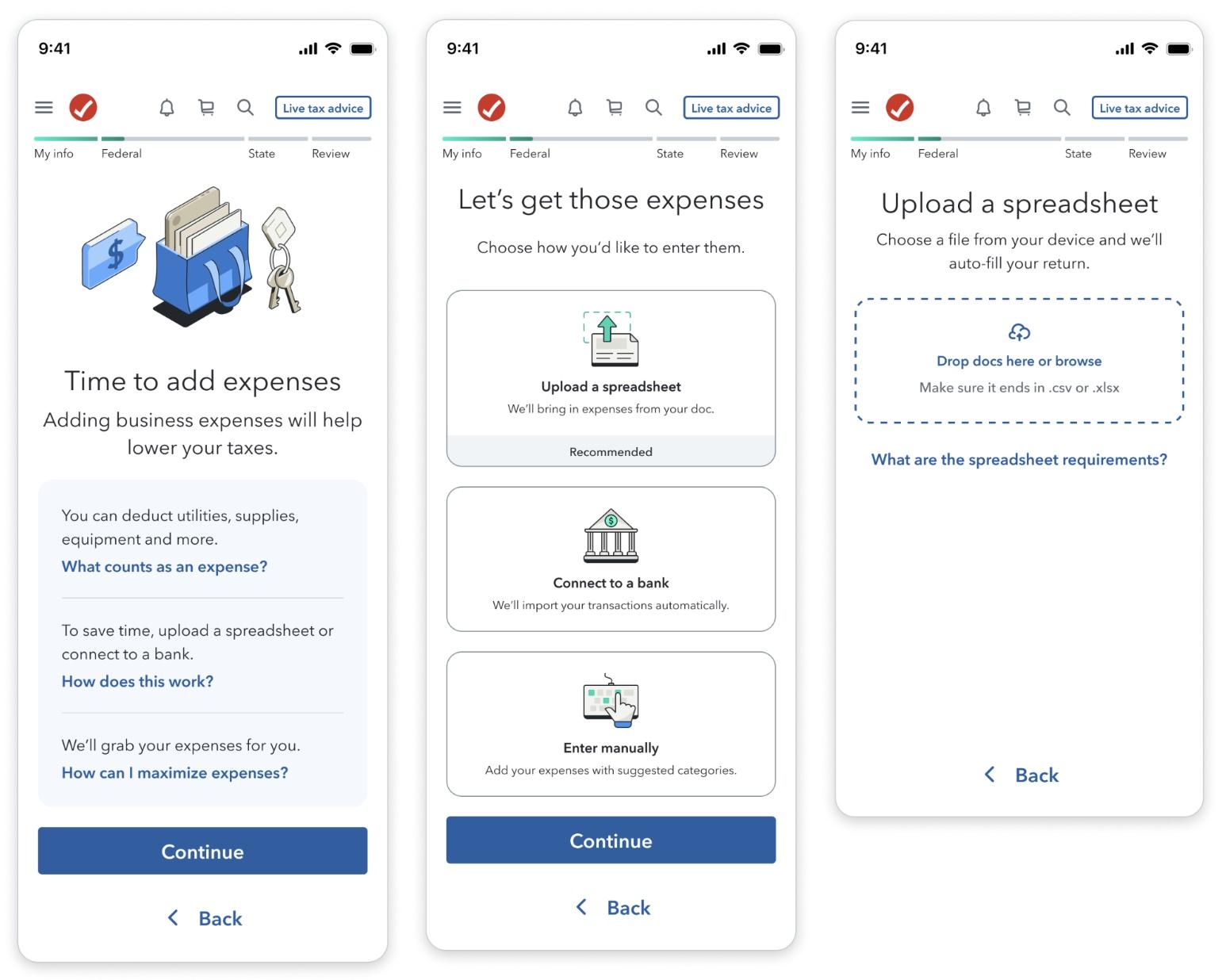
Both variants also linked to a short demo of the upload flow, so customers could preview the capability and the time it saves before committing — a shared move that addressed trust deficit and effort misperception independent of layout.
Challenges
Engineering capacity capped the experiment at two net-new recipes. With only two slots to spend, each one had to earn its keep — a sharp hypothesis, a distinct treatment, and clean enough attribution that the read could survive late-season noise. That forced an upstream discipline: be intentional about what we were trying to learn before we picked the variants, not after.
We were also under pressure to deliver conversion gains without introducing risk to existing performance. Any variant that could damage conversion at scale would do more harm than the upside, which bounded the design space — the variant that broke visual parity had to be confident enough in research to be downside-bounded, not just experimentally interesting.
What I learned
Trust is mostly built in design, not in the model.
The highest-impact change wasn't a model improvement — it was making the review step visible before commitment, naming the format reassurance directly, and breaking visual parity with the manual flow people had habituated to. Customers in interviews didn't ask for better categorization. They asked to see that they were still in control.
Copy alone doesn't move take rate on a habituated surface.
The clear-expectations variant we tested — same three-tile layout, updated language — performed roughly at baseline. The variant that won broke visual parity and led with the AI-forward action. Pattern-interrupt is a design move, not a copy one.
Diagnose before you design.
Supply, value, and perception each call for a different fix; starting with the wrong frame ships the wrong thing. Spending the week on a survey before any pixels moved was the choice that made every downstream decision faster.
Feedback
Kaci has been great at driving the work for increasing the take rate on this surface. The project had a few other PMs in it to start, but then it became hers to take over and she did so seamlessly. Kaci was super collaborative throughout research and design iterations. She provided her input quickly and made sure we were considering all of the biggest points from the research studies. Her speed gave us momentum as a team as we quickly implemented feedback from our working team and various stakeholders to get to a place that we all felt was the best call.
Content designerTurboTax partnerI had the pleasure of working with Kaci on the take-rate experiment that helps Self Employed customers in TurboTax add their expenses. It was a project with tight deadlines. Kaci demonstrates a deep understanding of the agent ecosystem — she effectively translated the complex goals of the take-rate experiment into clear, actionable requirements by delivering a thorough PRD with well-structured Jira tickets already created for the team, which ensured our technical execution aligned perfectly with the product vision from the start. She's incredibly organized and thorough in running our operational mechanisms, consistently keeping the team unblocked so we're fully equipped to deliver on schedule. She regularly updates the team channel with clear standup notes, which has been crucial for keeping everyone aligned throughout the experiment. She's highly collaborative and genuinely easy to work with, making cross-functional partnership seamless. And she ensured UAT was completed promptly and thoroughly, directly safeguarding the customer experience and ensuring we collect clean, reliable experiment data. Would love to partner with you on future projects.
EngineerTurboTax partner
Highlights
- Proposed and led two specialized AI enablement workshops (AI Fluency and Agentic Skills) for ~60 Product Managers, empowering the broader org to design, prototype, and ship AI-native features without bottlenecking on a centralized AI engineering team.
- Drove a 46% improvement in prompting proficiency (measured via Anthropic's behavioral indicators), yielding an 84-point increase in iterative prompting while identifying AI discernment as the next major training opportunity.
Overview
Alongside the agent work, I saw an opportunity to upskill the TurboTax PM org so teams could design and ship AI-native features without constantly waiting on a centralized AI team. To help bridge this gap, I proposed and designed a foundational AI Fluency workshop, and subsequently volunteered to develop and lead a deeper dive on Agentic Skills. About 60 PMs went through the sessions.
These two topics required different approaches because they serve distinct functions in a PM's toolkit. AI fluency is foundational and durable—tools change, but the underlying mental models remain—which warranted its own dedicated treatment. The second session focused on agentic skills, representing the applied layer of AI product management. As the industry moves toward a skills-driven architecture, designing for and building with these skills is quickly becoming core PM craft.
Workshop 1 — AI fluency
45 minutes. The goal was for every PM to walk out able to use AI more effectively and evaluate AI output more critically.
We opened with why PMs need AI fluency and product sense, ran a baseline prompting exercise, walked through Anthropic's AI fluency competencies framework, had PMs apply it to their own outputs, and closed with a recap of takeaways.
Workshop 2 — Agentic skills
60 minutes, slides → demo → hands-on exercise. The goal was for every PM in the room to walk out able to build a functional agent skill and explain the basic building blocks.
We covered why PMs should care about skills, the benefits worth building toward (consistency, compounding quality, shareability, embedded domain knowledge), and the signals that tell you when a skill is the right move. Then we covered the "how"—skill structure, progressive-disclosure loading, description triggers, the specification criteria checklist, and design/test/iterate best practices. We closed with an applied exercise so people left having actually built one.
Post-Workshop Analysis
After the fluency session, I had Claude run an analysis on PMs' prompts before and after the training—25 initial transcripts and 16 refined—using Anthropic's behavioral proficiency indicators. Refined prompts averaged 5.1 behaviors vs. 3.5 for the initial set, a +46% lift.
A handful of behaviors moved the wrong way—most visibly define target audience (84% → 69%) and consult on approach (24% → 19%). Some of that likely says more about the task than the workshop: the prompt we gave PMs asked them to generate a pitch to a VP, which pre-supplied the audience and constrained the format. Because several of those indicators started near the ceiling, they had nowhere to go but down.
Like all studies, there are limitations: it relied on output-only transcripts (offering no view into the reasoning behind a prompt), utilized a constrained task that inflates some behaviors while depressing others, featured a small sample size, used binary classification that misses depth, and had no accounting for context PMs may have carried in via portable memory. It provides directional signal, not a controlled study.
Despite these constraints: we saw iteration and refinement shift up, proving the workshop successfully pushed PMs past "one-shot" prompting. However, the data also highlighted that discernment—specifically checking facts and questioning AI reasoning—remains the largest skill gap to address in future training.
Feedback
You're exceptional at navigating tough product trade-offs. You strike a thoughtful balance between the ideal state and an MVP, and between the best possible UX and business impact. I genuinely trust you to make the final call on hard product decisions because I know the customer experience will always stay front of mind, even when the path forward requires compromise. You're also incredibly open to differing opinions — you invite pushback, give strong feedback in return, and collaborate well even when we don't initially align. That combination of decisiveness and openness is rare and makes you a great partner. I also want to call out how much you're leveling up the team's use of AI. You actively share resources, demonstrate how AI can accelerate the product development lifecycle, and bring others along instead of just doing it solo. A standout example: a few months ago you pushed me and a researcher to use Cursor connected to a real LLM to "fake" the conversational experience for user testing. It let us gather meaningful feedback on a potential agent before tapping any dev resources, and shrank our research timeline from four weeks to two days. I also love the provocations you send out through Claude Code — they consistently spark new thinking. You're modeling what it looks like to use AI effectively, and the whole team benefits.
Product designerTurboTax partnerI'd like to recognize Kaci for going above and beyond in sharing how Cursor was leveraged across user research and product experience development. The materials were thoughtfully organized and clearly connected to real product workflows, making the learnings immediately relevant and actionable for cross-functional teams. By proactively distilling insights and investing time in creating a reusable learning resource, she helped the team better understand how AI tools can accelerate discovery, decision-making, and execution. This shows growth mindset and a genuine commitment to helping others learn and succeed.
Senior staff product designerTurboTax partner